
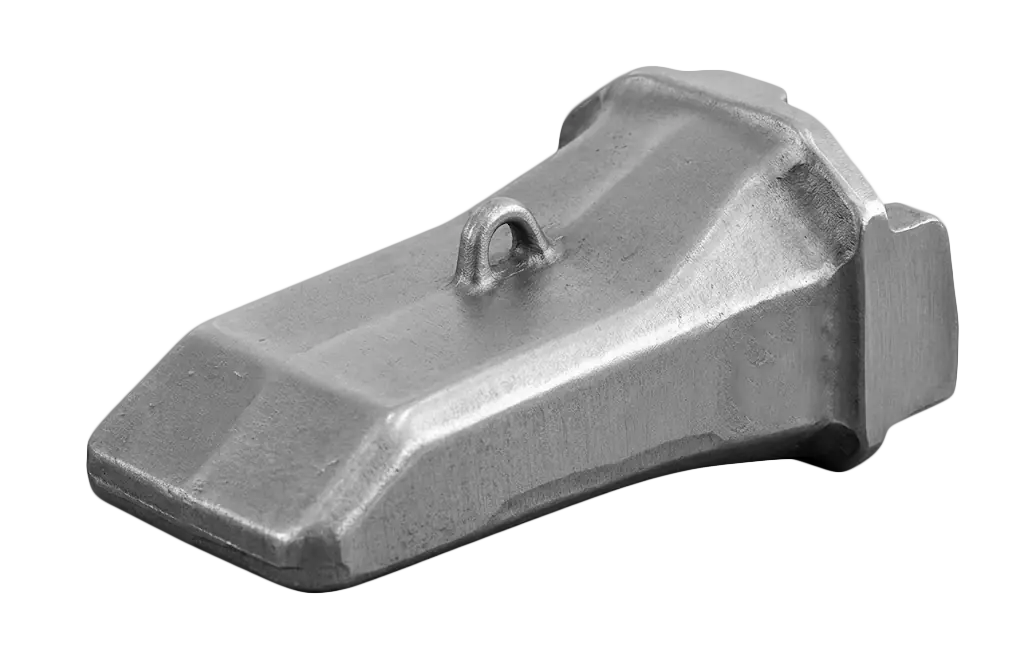
Ground engaging tools are the first components to meet the material. Tooth geometry influences penetration, but material properties, adaptor support and cast-lip structure determine whether the complete system can survive repeated impact and abrasive flow. Selection should therefore begin with the load path rather than the tooth alone.
Select GET as a connected system
The bucket tooth cuts into the material, the adaptor transfers bending and shear forces, and the cast lip distributes those loads into the bucket structure. A highly wear-resistant tooth cannot compensate for an adaptor or lip configuration that does not match the operating condition.
Use verified properties as selection inputs
STRUMEX bucket teeth are produced from high-strength alloy steel refined through EAF and AOD processes, then through-hardened and aged to 50–55 HRC with Charpy V-notch impact energy above 20 J at -40°C. Adaptors are quenched-and-tempered alloy wear steel at 260–300 BHN with 50–80 J KV at -40°C. Cast lips are specified at 260–300 BHN with 70–90 J KV at -40°C.
Geometry must support retention and service
Tooth profile affects penetration and retained shape as it wears. The adaptor must maintain compatible pin-and-retainer geometry, while precision machining of tooth-adaptor seats and interface dimensions supports drop-in fitment. These details influence both operating reliability and replacement time.
Cast-lip structure carries the system
STRUMEX integrated cast lips use monolithic construction without welded seams. Catalogue specifications cover cast-lip weights from 3,000 to 15,000 kg per piece, with integral wear inserts available. Final selection should connect lip size, tooth system, expected impact and bucket structure to the actual mine duty.